Sending and reminders
When an email goes out, and how often your employees are chased, is controlled per rule in the Settings tab of the rule editor, in the sending area. The defaults suit most organizations: event emails go out immediately, feedback reminders after 7 and 14 days, and target agreement reminders 7 days before the deadline.
Immediately, when the event happens
Immediate sending is the normal case: the email goes out as soon as the event occurs. For feedback invitations this option is called “Invitation”, for sealing “Confirmation request”, and for user invitations “Account invitation”.
Chasing participants: reminders for feedbacks
You set up reminders as their own rule, using the Reminder sending option. They are sent a configurable number of days after the invitation, and only to people who haven’t yet completed their participation. Anyone who is already done is left alone.
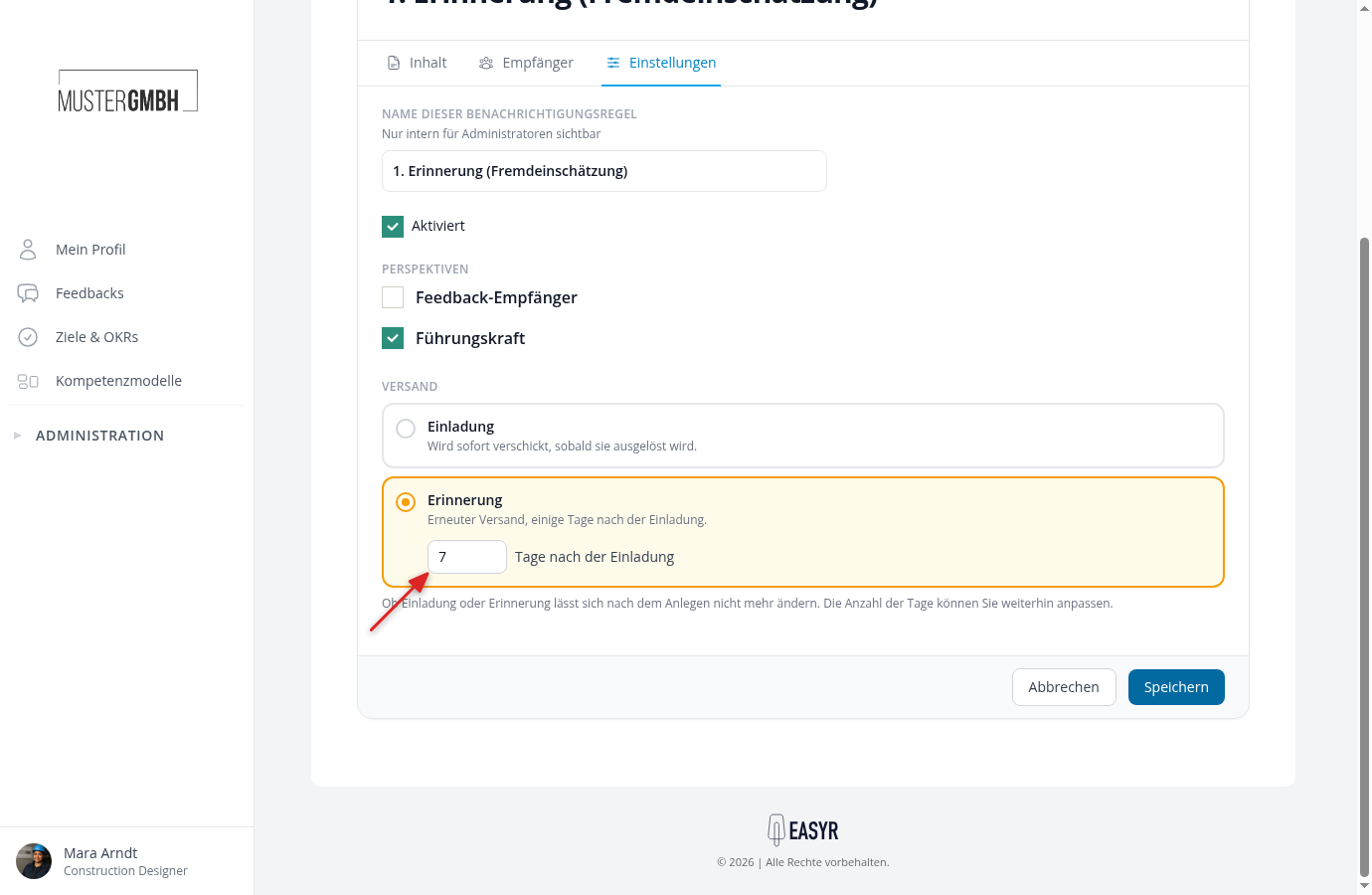
By default, every feedback process comes with a 1st reminder (after 7 days) and a 2nd reminder (after 14 days). You can adjust the days, disable reminders, or add more reminder rules.
Reminding before the deadline: target agreements
For a target agreement reminder, the value counts backwards: the email is sent the configured number of days before the deadline of the target agreement or the goals that are due. That gives everyone involved time to react before anything becomes overdue.
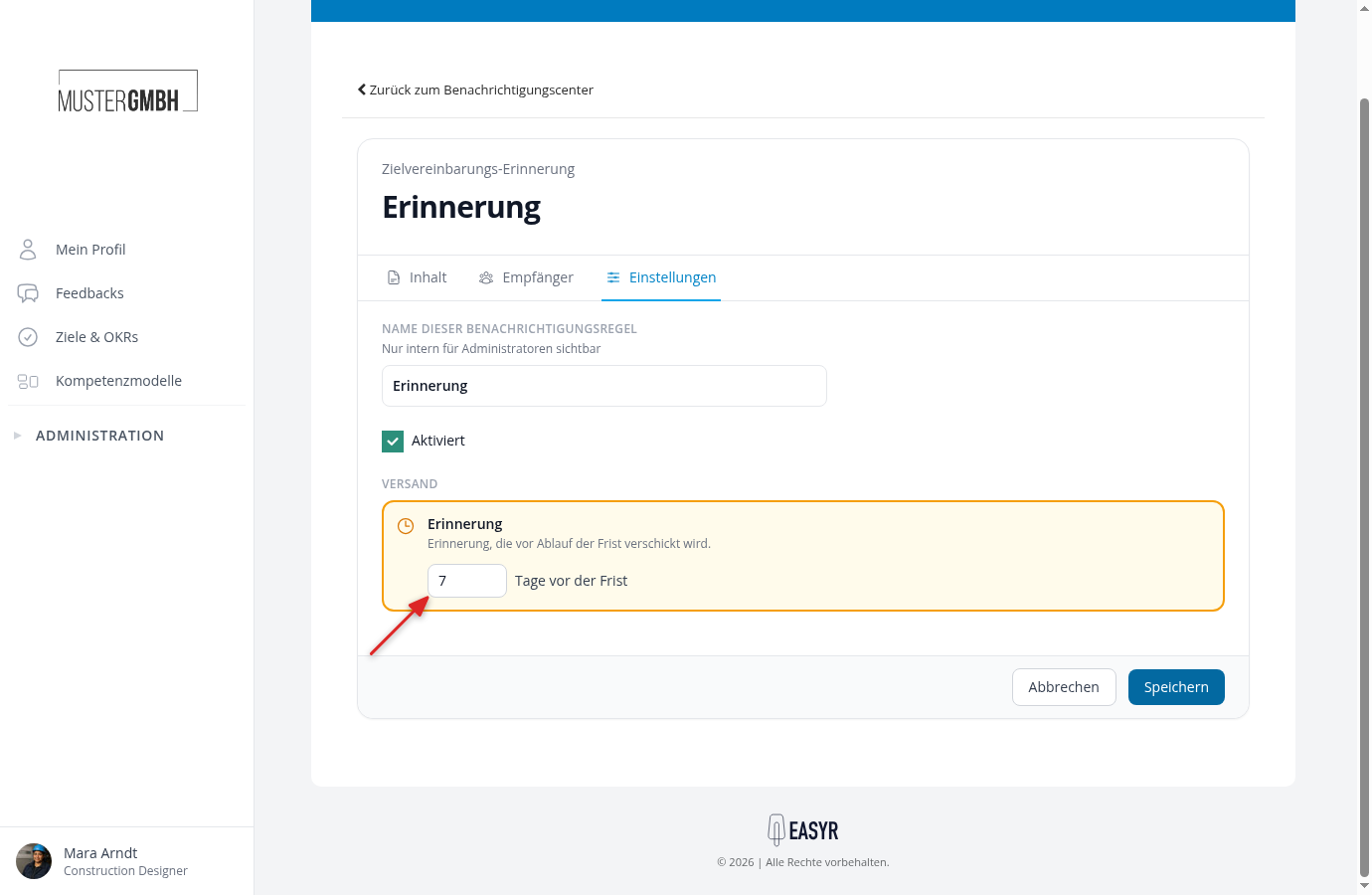
For the full instructions, including where the deadlines come from, see Set up reminders for target agreements.
Writing to specific perspectives only
Rules in a feedback process apply per perspective. Under Perspectives you choose which perspectives the rule applies to, for example only the supervisor perspective (external assessment) or only the self-assessment. At least one perspective must be selected.
This lets you word invitations and reminders separately for self-assessment and external assessment, and time them differently. That’s why the built-in default rules are already split by perspective (for example “Invitation (external assessment)” and “Invitation (self-assessment)”).