Set up process steps
You configure process steps once per target agreement process. The steps then apply to all editions; when they run within an edition is set separately in the edition’s schedule. You need HR access.
If you are still deciding which steps your process needs, read What are process steps? first.
Open the step list
- Click Objectives in the sidebar and open the target agreement process.
- Click Settings at the top right.
- In the Process steps section, click the Configure process steps tile.
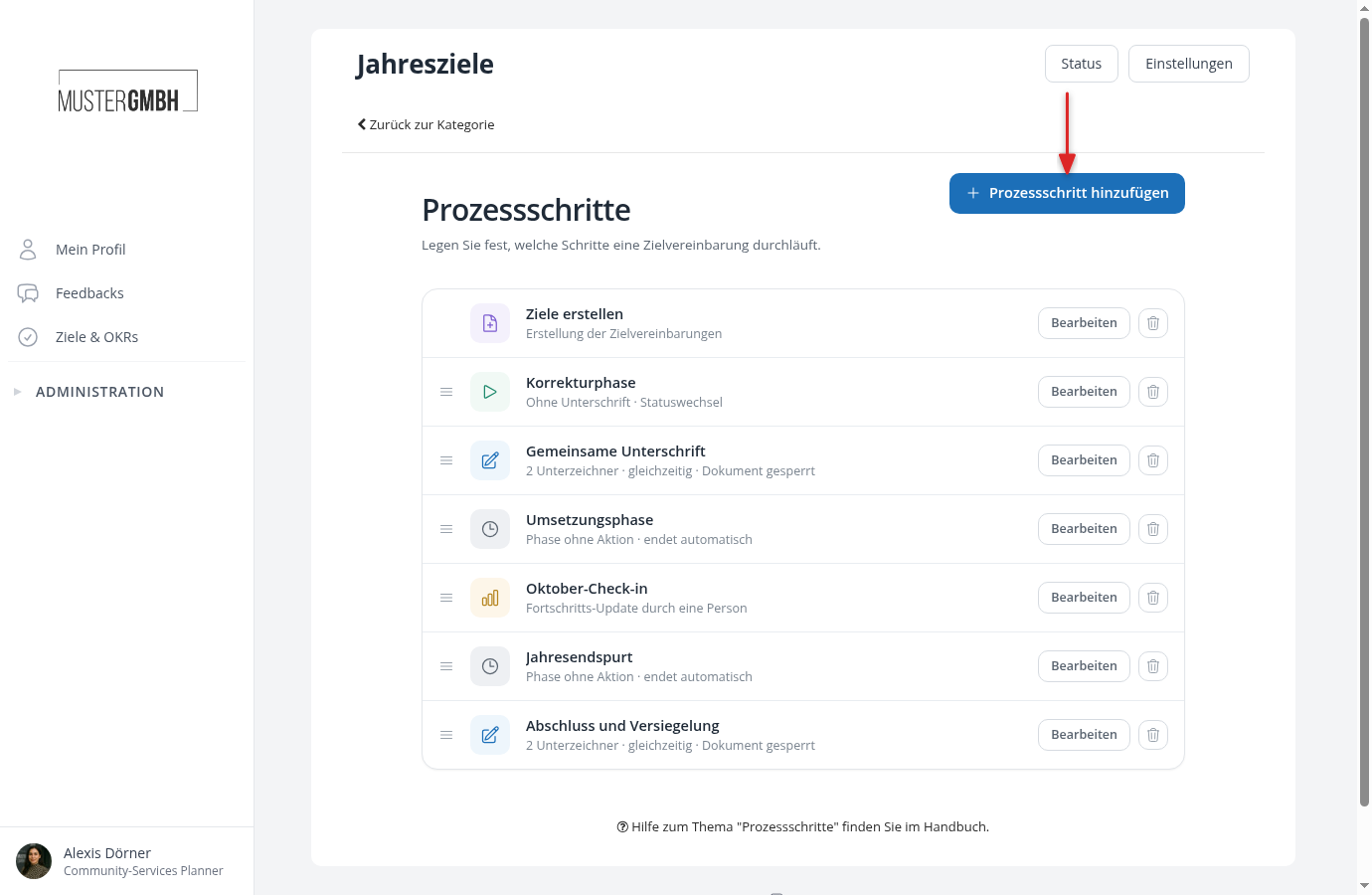
The list shows all steps in order. Reorder them by dragging the handle; only the “Create objective” step is always first.
Add a step
- Click Add process step.
- Pick the kind of step under Choose type and click Continue. The type cannot be changed later.
- The editor of the new step opens. Enter a name at the top; it appears everywhere the step shows up (timeline, emails, tasks).
- Configure the step as described below and click Save.
Optionally enter an action label. This text replaces the default caption of the action button, for example “Release now” instead of “Confirm Sealing”.
Create objective: audience and creator
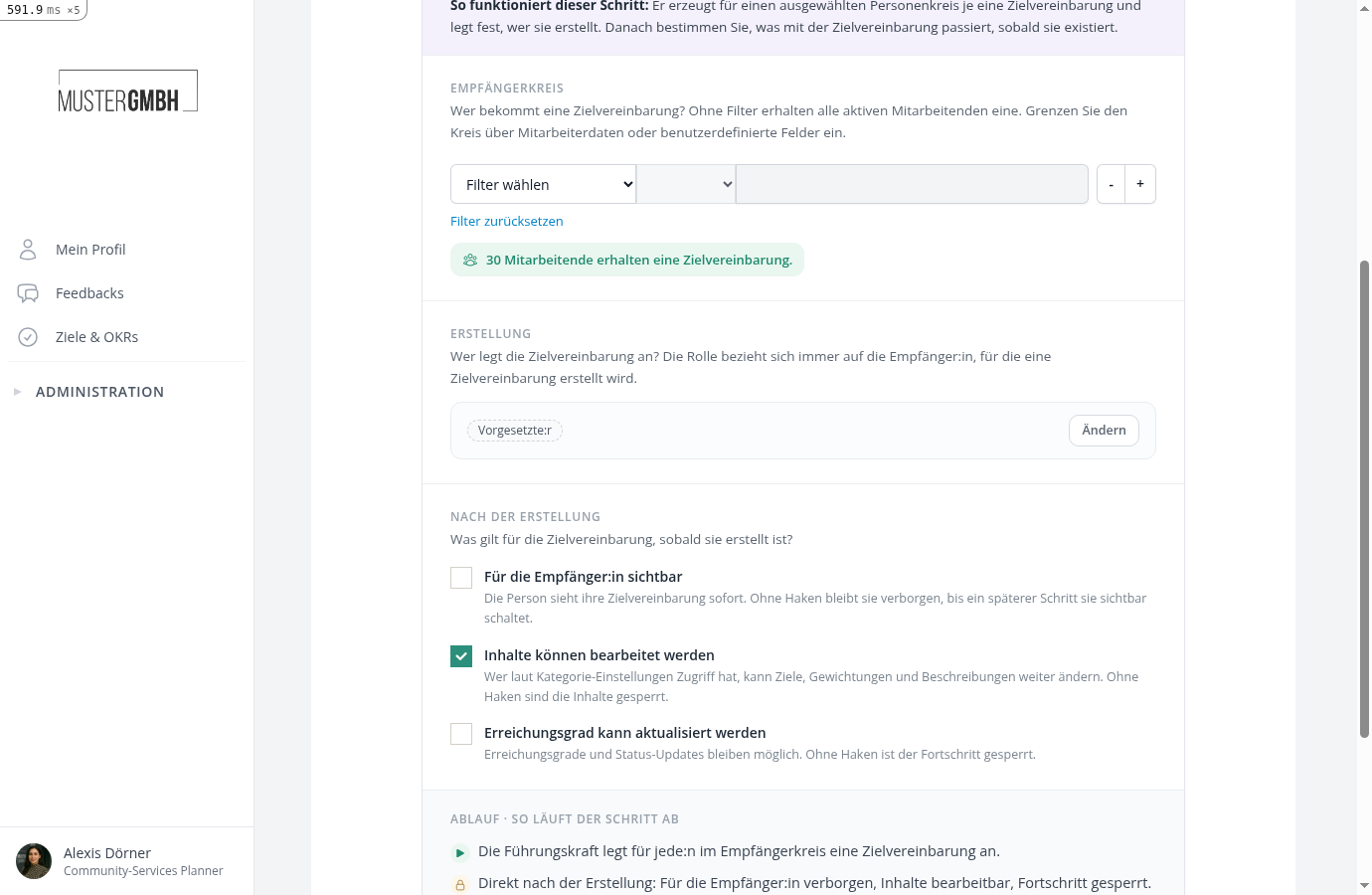
The create step answers two questions: who should get a target agreement, and who creates it?
- Audience: without filters, every active employee gets one. Use filter rows to narrow the circle, for example by group, location or custom fields. The filters work like in the employee list, and easyreview shows a live count of people currently in the audience.
- Creator role: usually the supervisor. easyreview shows the responsible people every still-missing target agreement as a task list, in the edition’s To create tab.
- After creation: decide how a freshly created target agreement starts: visible or hidden from the recipient, content open or locked, progress open or locked. The default is a hidden draft with open content and locked progress.
Sealing: who signs, in what order
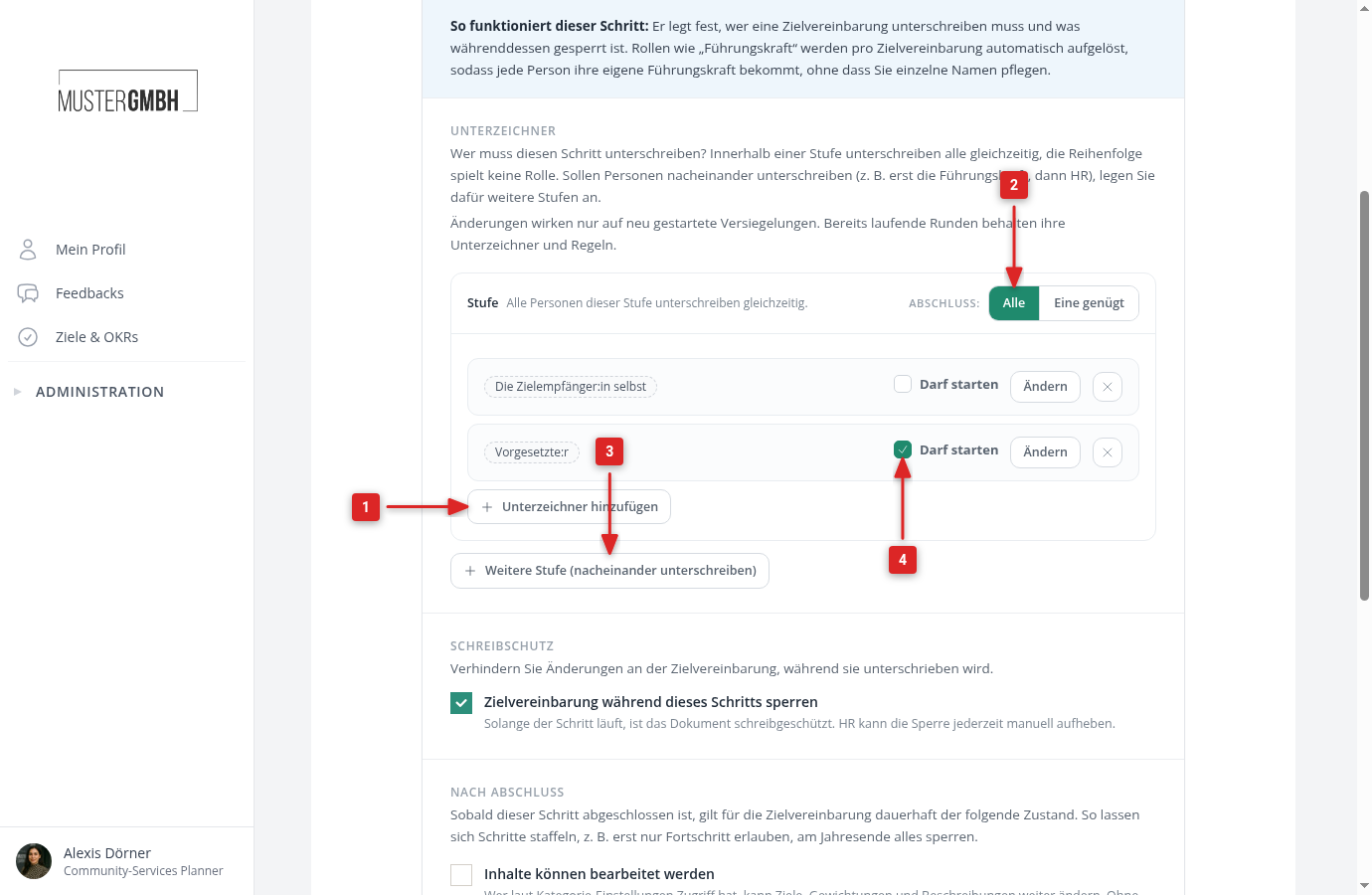
In the Signers section you assemble the committee:
- Add the signers of the first stage. Available roles include the employee themselves, the supervisor, the next-level or top-level supervisor, a specific person, a user group or a person from a custom field.
- Within a stage, everyone signs in parallel. For the completion rule, choose All or One is sufficient. With “One is sufficient” the first signature completes the stage; the remaining requests of that stage are marked as no longer required.
- If people should sign one after another (first the supervisor, then HR), click Another stage (sign one after another) and fill the second stage. It only unlocks once the first one is complete.
- Mark at least one person with May initiate. These people may open the sealing round. HR can always start it.
The flow preview below the committee describes in plain sentences how the step will run with the current configuration. Check it before saving.
You also define:
- Write protection: with “Lock the objective during this step” the document is read-only while it is being signed, so everyone signs the same state.
- After completion: whether content and progress are open or locked once the sealing is done.
Status change: release with one click
For a status change you define who may trigger it (a role, plus always HR) and what the click does: visibility, content and progress switch to the configured values. The most common use is releasing a hidden draft to its recipient.
When triggered, easyreview freezes the current state as a Status change document (PDF), so it stays traceable what exactly was released.
An accidentally triggered status change can be taken back: the authorized triggerers and HR find the Take back status change action in the small arrow menu next to the completed step in the timeline. The step reopens, its effects fall back to the previous state and the frozen document is discarded; triggering again freezes a new one over the then-current state. As with removing sealings, later steps must be taken back or removed first.
Record interim update: guided check-in
Here you only pick the responsible person (a role, for example the supervisor). How the step works for them is described in Record an interim update as a process step.
Working phase: a time window without a task
The working phase has no participants and no configuration besides its name. It ends automatically on the end date you set in the edition’s schedule. Use it to make visible in the timeline that people are currently working on their objectives.
Change, remove or archive steps
- Edit: open a step via Edit in the list. Changes to roles and settings apply immediately.
- Remove: a step no edition has scheduled yet is fully deleted when you remove it.
- Archive: if the step is already scheduled or has run, removing it archives it instead. Archiving stops the step immediately and everywhere: it no longer activates in any edition and sends no further notifications. Completed runs stay visible in the target agreements’ timelines. Signature rounds still running on the step are aborted and signatures already given become void; easyreview warns you beforehand with the exact count. If running signatures should finish first, archive the step later.
Emails for process steps
As soon as a process has process steps, its Notification Center gains four additional email types: the prompt to whoever a step is waiting for, the reminder before step deadlines, the signature request and the confirmation after a completed sealing. You customize all four as usual. See Notifications for target agreements.